PCB Board Defects with Anomaly Detection
Heatmap anomaly localization · Reduced labeling · Production-friendly post-processing
Overview
This project targets defect detection on PCB boards (e.g., short circuits, missing/extra patterns, irregular traces) where labeled defect samples are limited. The system produces pixel-level anomaly heatmaps and a final OK/NG decision using robust scoring and post-processing.
Problem
- Defects are rare and diverse → hard to collect balanced labeled datasets.
- Small defects need localization, not only classification.
- Variations in lighting/PCB layouts can cause false alarms.
Solution
- Train mainly on normal samples (unsupervised/weakly-supervised anomaly learning).
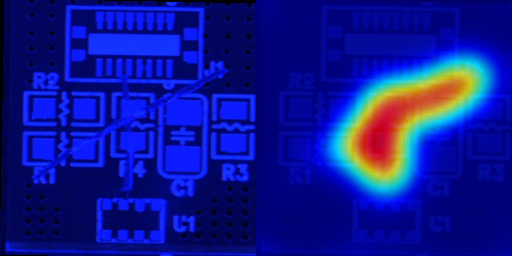
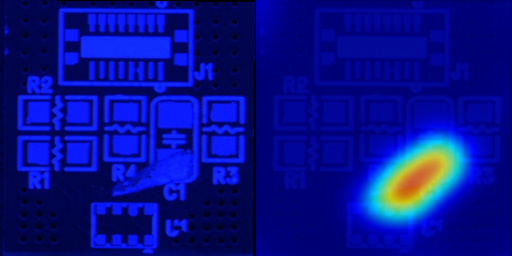
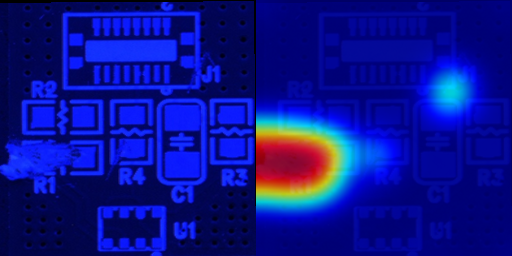
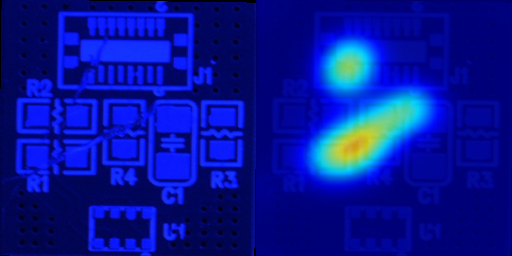
- Generate anomaly heatmaps → localize suspicious regions.
- Compute defect score from ROI heatmap stats (max/mean) and apply tuned thresholds.
- Post-processing: smoothing + morphology + connected components for stable decisions.
My Role
- Designed the end-to-end anomaly pipeline producing heatmap-based defect localization.
- Handled limited labels with anomaly learning strategy and strict validation.
- Optimized post-processing and thresholds for robust decisions in production.
Implementation
Language: Python
Libraries:
PyTorch
OpenCV
NumPy
Outputs: Heatmap · Binary mask · Defect score · OK/NG decision
Deployment notes: ROI cropping + threshold tuning per PCB type for stable performance
Anomaly Map Gallery
Training Demo
Short clip showing the training process / anomaly map learning.